This is a phrase I hear often. And to be honest it drives me crazy. I myself love hoppy beers. I even consider myself a hop-head. But what bugs when people say they don’t like hoppy beers is that I don’t think that’s what they mean at all. Most of the time what they actually mean is they don’t like bitter beers.
Hoppy Beers Don’t Have to be Bitter
There seems to be a pervasive opinion that hoppy equals bitter, which is not really the case. It all comes from the way the hops are used in the beer-making process. Many hoppy beers can be prepared in a way that they impart little to no bitterness.
To Isomerize or Not Isomerize
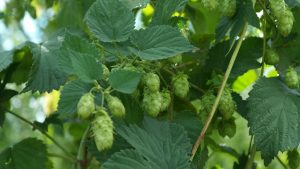
Without getting too technical, there are oils in the hop flowers which are responsible for the hoppy flavors. At very high temperatures, above 180˚F, these oils break down and impart bitterness. The oils are isomerized, and alpha acid is released into the beer, and that is the main source of the bitterness. Most beers are boiled for 60 minutes and hops are often added during this phase. The earlier the hops are added in the boil, the more they break down, and thus the more bitter the beer becomes. The later they are added, the less they break down, which translates to less bitterness.
Let’s Dry Hop this Bad Boy
But some brewers don’t even add hops during the boil, or they add very little. They add the hops after the boil and often after the beer has been dropped below 180˚F so the oils do not break down at all, and they continue to add more hops during the fermentation process. This is called dry hopping. What happens now is the magical flavor of hops. This is where the floral notes are imparted into the beer. You often hear beer described as “floral,” “citrusy,” “spicy,” “piney,” “lemony,” “grape fruity.” And don’t forget the word “dank,” but let’s save that for another post.
Would You Like Brussels Sprouts in your Beer?
I’m not sure if this is best analogy, but I’m going with it. I don’t like Brussels sprouts. I really can’t stand them. And what I don’t like is their bitterness. But I have had Brussels sprouts that I actually did enjoy. They were braised and caramelized and a bit sweet. What they weren’t was bitter. So like Brussels sprouts, hoppy beers don’t have to be bitter; it’s all in the way they are prepared.
Let’s Be Clear
My hope is for more clarity when it comes to talking about hoppy beers. I wish even bartenders would ask for clarification when someone says they don’t like hoppy beers. It’s a simple question. Do you mean you don’t like bitter beers? Because we have lots of hoppy beers that aren’t bitter.
Let’s Talk about Hazy
Hazy North Eastern IPAs have actually been around for a while, but we are definitely experiencing an explosion of the style right now, at least on the West Coast. And these beers are a perfect example of the low bitterness, super hoppy beers. Sounds like a contradiction in terms, but that is exactly what these beers are. It’s possible the explosion of this style is in direct response to the idea of people not liking bitter beers, but the message seems to be slow in getting out to the non-beer-enthusiast crowd. Beer enthusiasts are all over these beers. Yes, there are some purists who hate them. “Beer should be clear!” But the overwhelming response is pretty passionate. Hazy beers are everywhere. And since they are everywhere, we should be inviting those people who have always said “I don’t like hoppy beers” to try a hazy. Often times you will find you have converted a non-believer. And what more could you ask than bringing enlightenment to the world.
On January 18th, 2017, Hapa’s Brewing Company opened their doors for the first time. For co-owners Derek Tam and Brian Edwards, it was a time of excitement, but also uncertainty. Opening a brewery is a tremendous financial risk and the factors that lead to success are many and varied. Luckily for Hapa’s they quickly found the recipe for success.
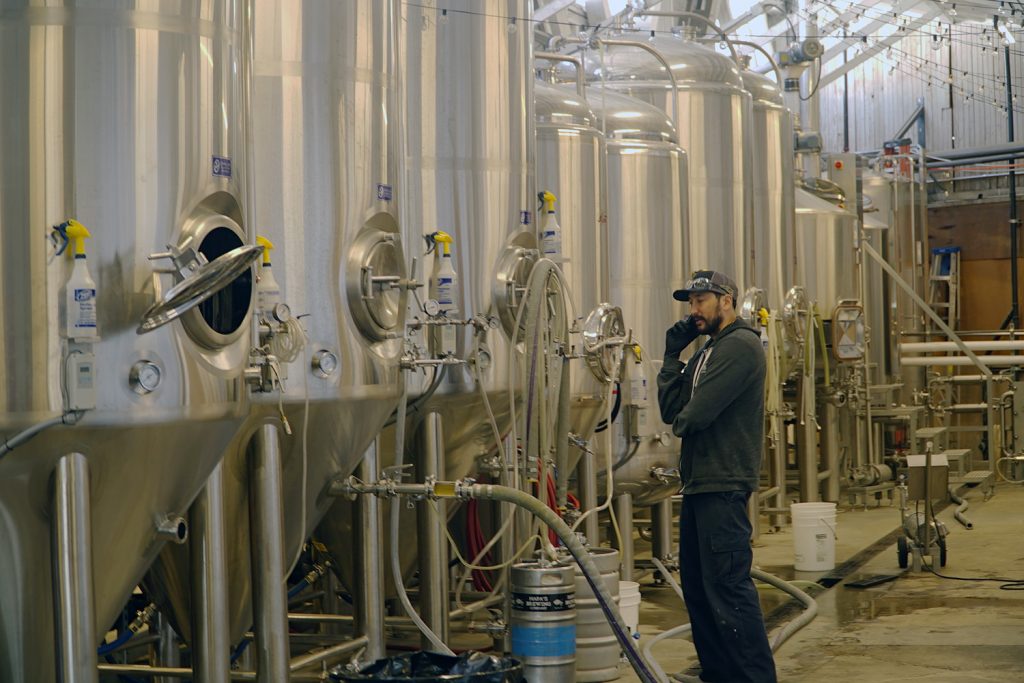
Head brewer Brian Edwards consulting on the phone with his mentor Pete Burrell.
As their 3rd Anniversary celebration was approaching on February 22nd, I had the opportunity to talk to head brewer and co-owner Brian Edwards about their success. Brian was super excited about the upcoming anniversary celebration and commented that he couldn’t believe it had been that long. When asked about their success, he said, “Most businesses fail in the first couple of years, so it feels good to have made it this far. I’m not surprised because we had a solid plan, a solid team and a solid location, and all those things helped contribute to our success.”
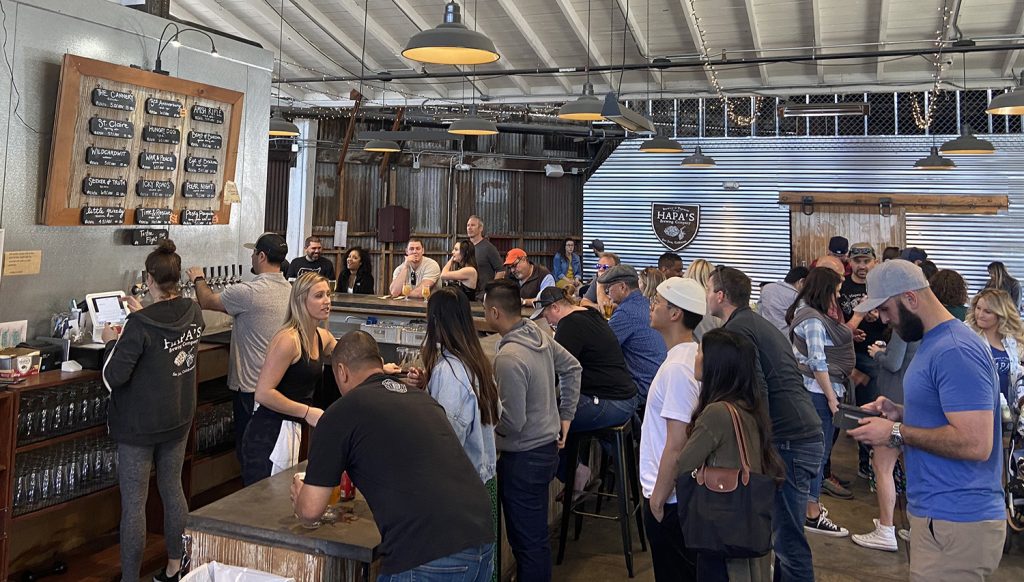
The crowds starting to form as the 3rd Anniversary party kicks off.
In the past three years, Hapa’s has added 105 BBLs of fermentation space, which is about triple what they started with when they opened. It has been a steady growth over the three years. It gives them a current brewing capacity of about 3000 BBLs per year. Last year they brewed 1200 BBLs and this year it’s too early to tell since they will be opening a 2nd taproom at a location in Los Gatos. They have maxed out their current capacity, but they have the space to double their capacity if they were to dig out floor space and put in a foundation that could hold the tanks.
Most of Hapa’s beer is sold in the taproom, but they also do monthly canning runs which then goes out to wholesale in grocery and liquor stores. Their beer is also on tap at a few restaurant locations.
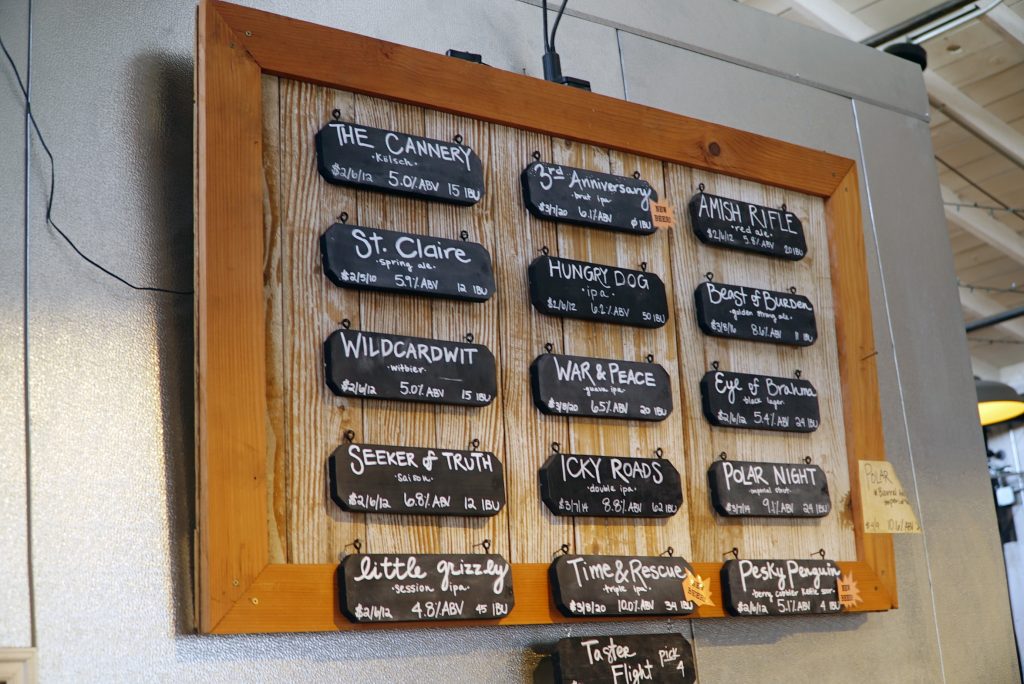
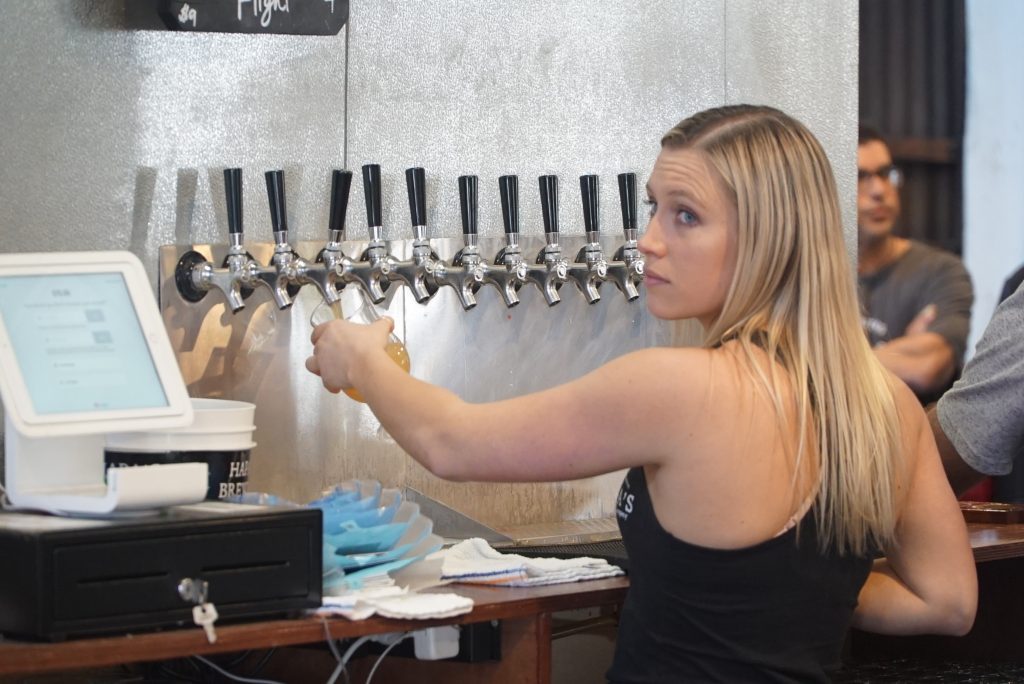
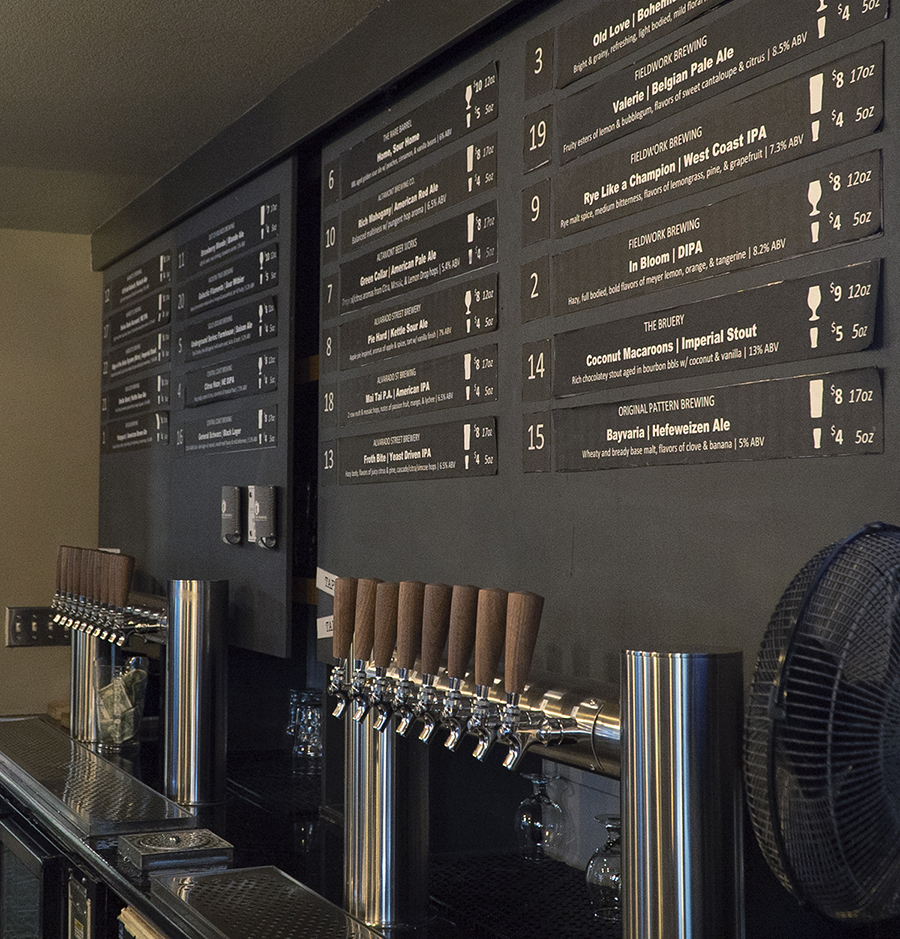
A full tap list with 15 beers on tap!
Brian’s background in brewing comes from his doing a stint at Dempsey’s Brewpub in Petaluma under the tutelage of Pete Burrell. Pete is a silent partner at Hapa’s and is still involved in an advisory capacity. As Brian describes Pete, “He is one of the OG craft brewers, back in the eighties, even before the first big run on craft beer and he also survived when the bubble burst.” Brian often bounces ideas off Pete in terms of recipe formulation and troubleshooting when things seem to be going awry. Also, Pete’s background is in a brewpub, so he has the restaurant experience which has been invaluable to Hapa’s as they plan their taproom in Los Gatos.
Brian’s training at Dempsey’s focused more on the old-school style of brewing classic styles of beer, and as he said, “Even (Dempsey’s) IPA would be considered conservative by today’s standards.” Starting his own brewery, Brian had to change his mind set with regards to the current trends. He had to learn how to make hazies and kettle sours, which have become very popular with Hapa’s fans.
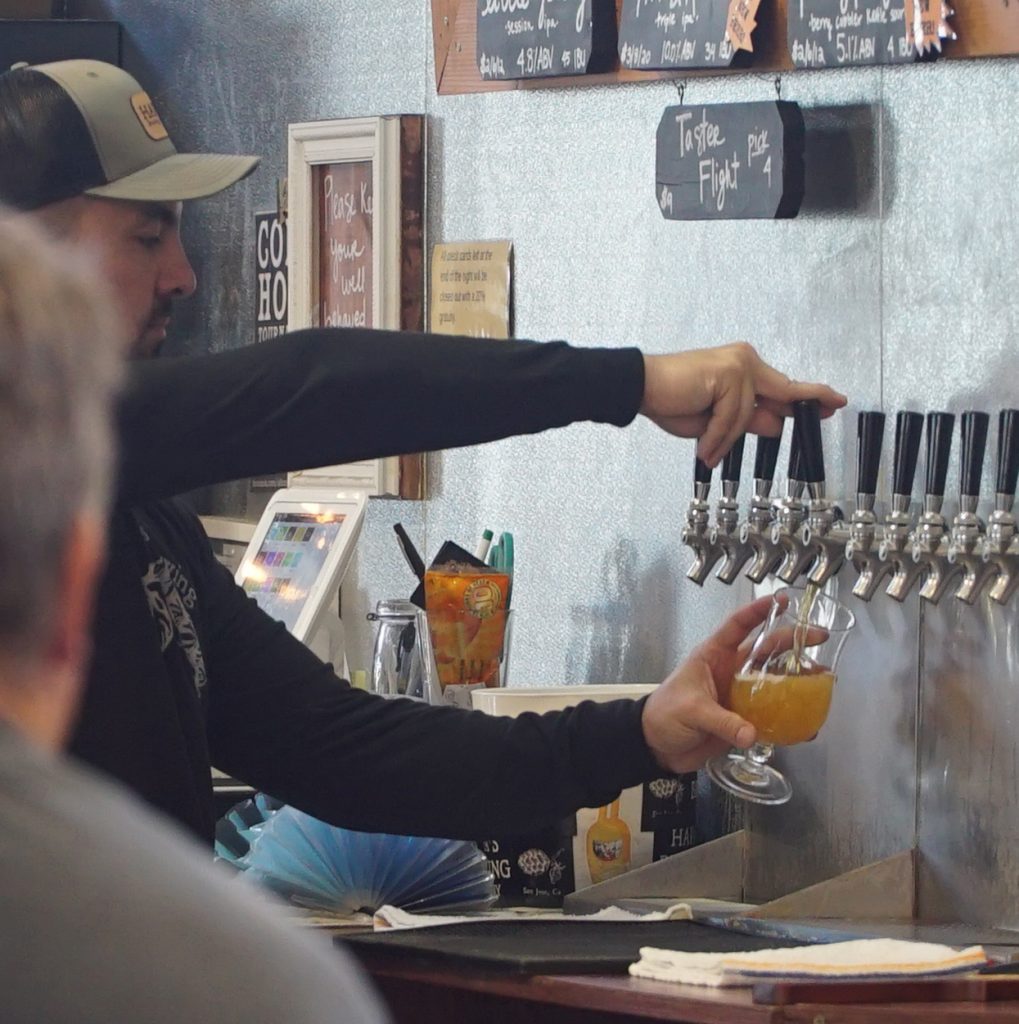
Co-Owner Derek Tam jumps in to keep the beers flowing.
As Brian says, “the Haze Craze is strong” and hence their most popular beers are the hazy style beers. He says he would love to try new styles, but he worries that they won’t be as popular. “Our philosophy is to make what our customers want. It doesn’t necessarily mean that’s what I want to make, but that’s who buys our beer and it’s our customers that we are here to serve”
Hapa’s released their first triple IPA for their 3rd anniversary. It’s actually a collaboration with one of their favorite bands, The Tens. The beer is called Time and Rescue, named after songs by The Tens, called Time and Rescue. It clocks in at 10% ABV and features four heavy hitter hops, Bru1, Idaho 7, Citra and Mosaic. All hops were late additions, so not a lot of bitterness, but huge aromas and flavors coming from those hops. On the brew day, Brian said he wasn’t quite sure all the grain would fit in the mash tun, but luckily it all fit. He thinks he might even be able to add another bag of grain next time to bump up the ABV. The Tens played in evening for the 3rd anniversary event and although I wasn’t able to stick around that late, Brian assured me that The Tens would “blow the roof off the place.”
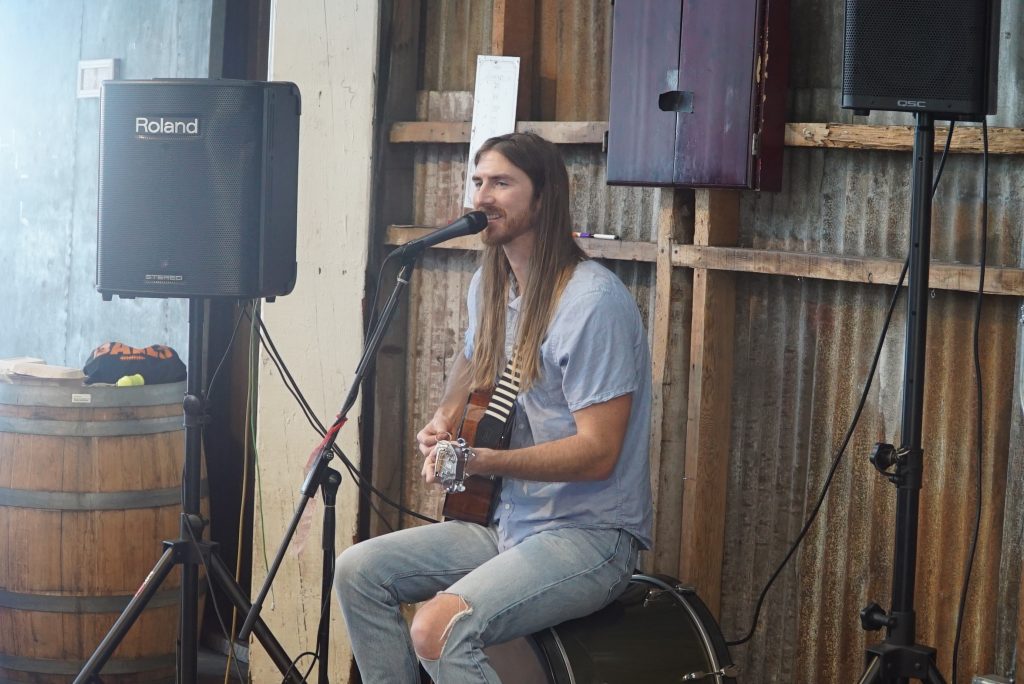
Solo artist Fourth Son performing at Hapa’s.
As Hapa’s has grown, so has their staff. They added an assistant brewer, Trey Schaaf. Trey has a strong background in the brewing industry, including working at the famed Rare Barrel in Berkeley. With his background at Rare Barrel there is the desire to put that skill to work in developing a sour program. They currently have four barrels [MOU1] with sour beer, but, as Brian noted, they would need some dedicated stainless-steel tanks to really dive into it. The four barrels each have a different treatment, with different bugs and different fruit added, so they can do a side-by-side comparison of flavors.
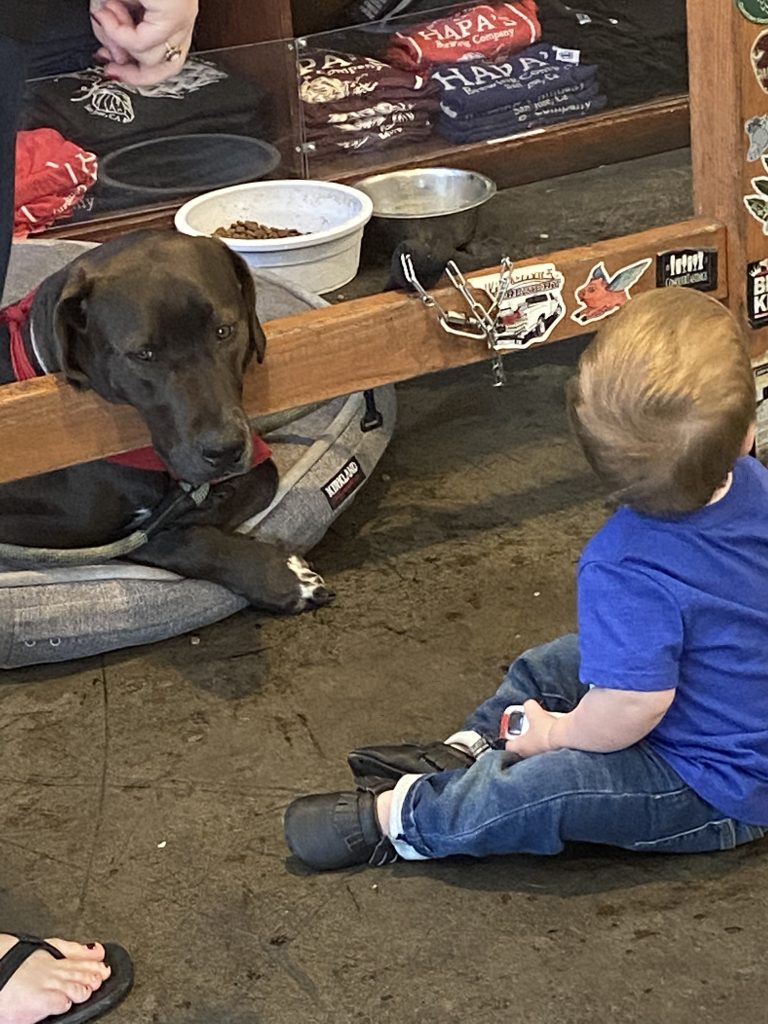
Donkey, the brewhouse dog, gets a visitor at the celebration.
The immediate future of Hapa’s is currently focused on the second location, the tap room in Los Gatos. They’ve been working on it for about two years, and it has been taking up a lot of their time and focus. Once they open, they will need to figure out logistically how to maintain two tap rooms. Brian has a hard time putting a date on when the second location will open, because he has tried so many times and has been wrong. Right now, he is saying sometime in 2020.
Hapa’s has become a staple of life in the Willow Glen area and a key brewery in the San Jose brewing scene. The quality of their beer and dedication of their staff and owners is a testament to their commitment to the brewing community and their fans in the San Jose area.
For most beer aficionados on the West Coast, hearing the name J Wakefield doesn’t set off any alarms. You generally have to be a serious beer nerd to be excited to hear that name on this side of the country. It is probably akin to someone on the East Coast hearing Alvarado Street Brewing and asking “Who are they?”
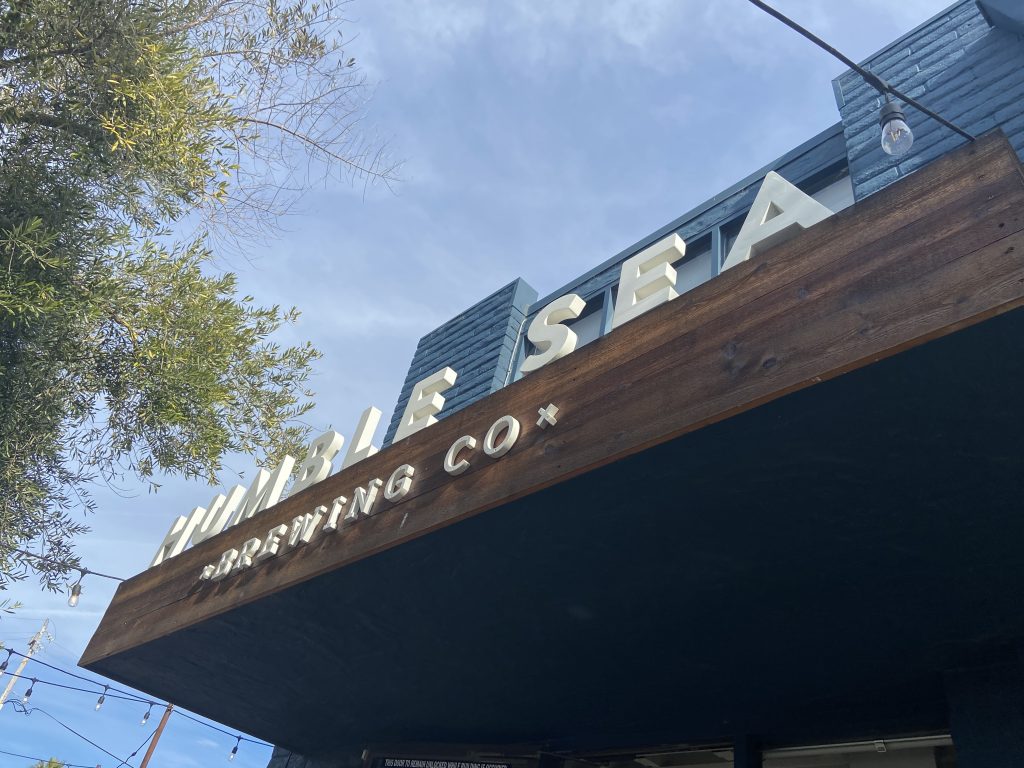
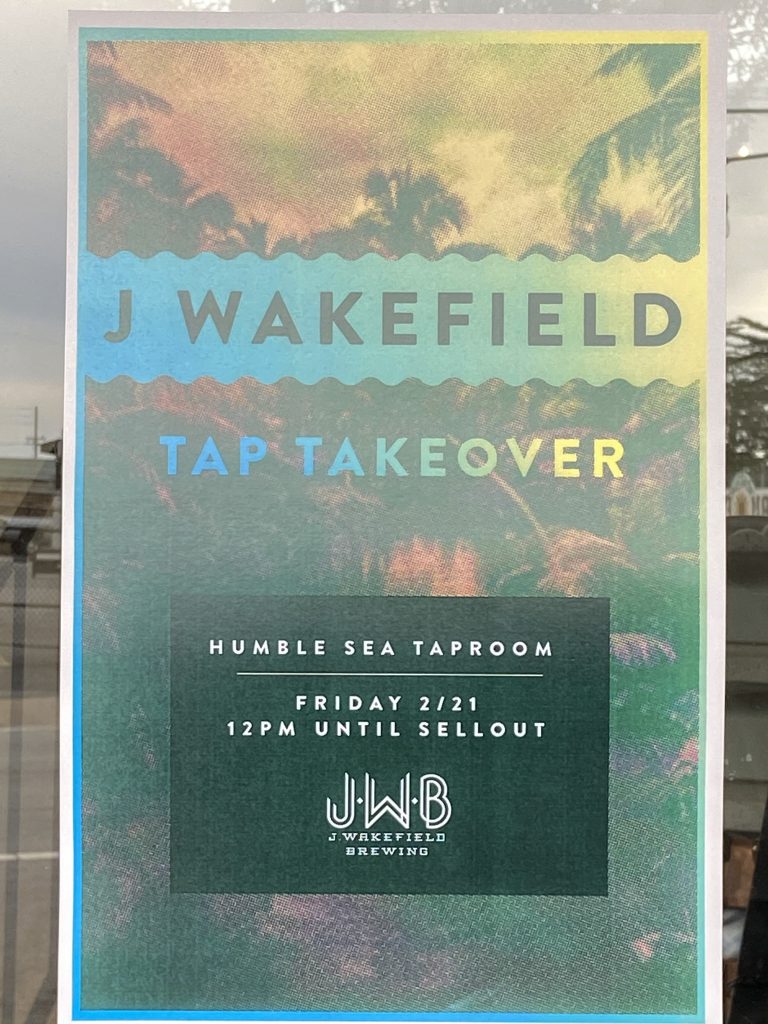
But when I saw that Humble Sea Brewing was doing a tap takeover with J Wakefield Brewing my ears perked up. At first I thought, “I know that name,” and somewhere in the back of my mind the word Florida popped up. Miami, to be exact. And to be clear, they are seriously respected in their neck of the woods.
Originally planned as a double tap takeover for SF Beer Week featuring both Other Half, from Brooklyn, and J Wakefield, it became clear that having them both on tap at the same time would be a bit of a madhouse. It was decided to split the tap takeover into two events, with Other Half taking place the last Friday of Beer Week and J Wakefield a week later on February 21st.
I arrived promptly at noon when Humble Sea opened and saw there was already a line out the door. Whether that was J Wakefield fans or the regular Friday noon crowd is debatable, but there were certainly a number of people there who were focused on the J Wakefield tap takeover.
Jonathan Wakefield has made a name for himself by creating beers that are outside the box. The brewery focuses on flavorful stouts and heavily fruited sours. On tap at Humble Sea was a handful of both and one Hazy IPA to satisfy the Hazy crowd. I saw patrons with trays of taster glasses either completely filled with dark stouts or with brightly colored sours.
Not being a huge stout fan myself, I quite enjoyed the fruited sours and Berliner Weisse. The stouts were great as well, but possibly a bit too sweet for my palate.
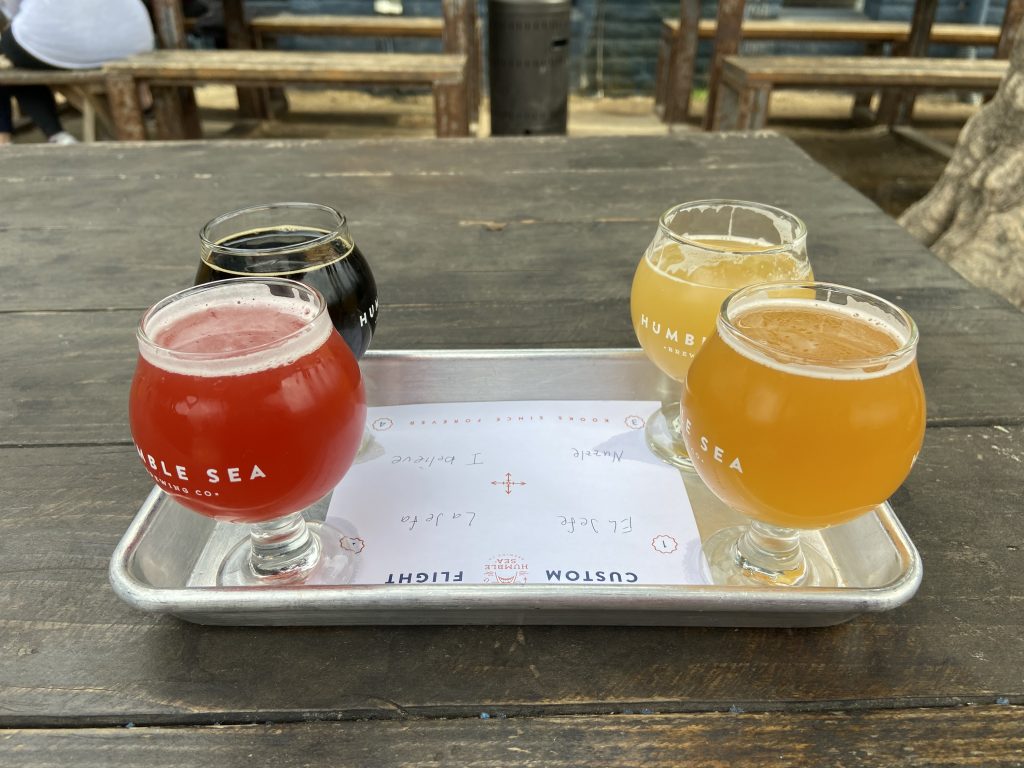
The relationship between Humble Sea and J Wakefield came about through mutual friends in the brewing industry, and while the guys from Humble Sea were in Florida for a beer event they did a collaboration with J Wakefield and brewed a fruited Berliner Weisse. Head brewer and co-owner Nick Pavlina thought the tap takeover would be a great idea for an event during SF Beer Week and could create a lot of excitement around East Coast breweries. Taylor West, Humble Sea co-owner and taproom manager, being true to their name of being humble, spoke of their high regard for these two breweries, Other Half and J Wakefield, and how thrilled they were to be able to offer these beers that are extremely rare to find on the West Coast.
These kinds of events can help expand the appreciation of beer across the wide expanse of our country. Although we are extremely lucky with the bountiful quality beer selection available to us here in the Bay Area, we shouldn’t ignore the amazing beer being produced far and wide across the United States. Events like this allow us to appreciate the remarkable offerings of quality beer available throughout the states.
As I began my journey into beer, there was one term that came up often, and although I had a decent understanding of it, I found myself explaining to many of my friends why they would want to drink something described as “dank.” Many times they looked at me askance and I usually resorted to just having them try some. I decided to turn to some professionals in the brewing industry to answer that question, “What is dank?”
When you walk into a bar or taproom you are in control; you decide what you want to drink. However, this event was a little like falling backwards blindfolded and hoping someone is there to catch you. It’s not quite that bad — falling hard on the ground isn’t the same thing as having a beer you don’t like — but there is an element of trust involved. I was totally on-board with letting our guides choose, though, and I trusted that they would take us along the righteous path.
Our guides for this event were Eric Schaefer of SF Adventure Tours and Chris Luecke of Pubcast Worldwide. Both were extremely knowledgeable in the world of beer and were great hosts for the event.
We met up with our guides at Cellarmaker, and although drinking before our trip was ill-advised, some of the patrons started their day at Cellarmaker, priming the pump, as it were.
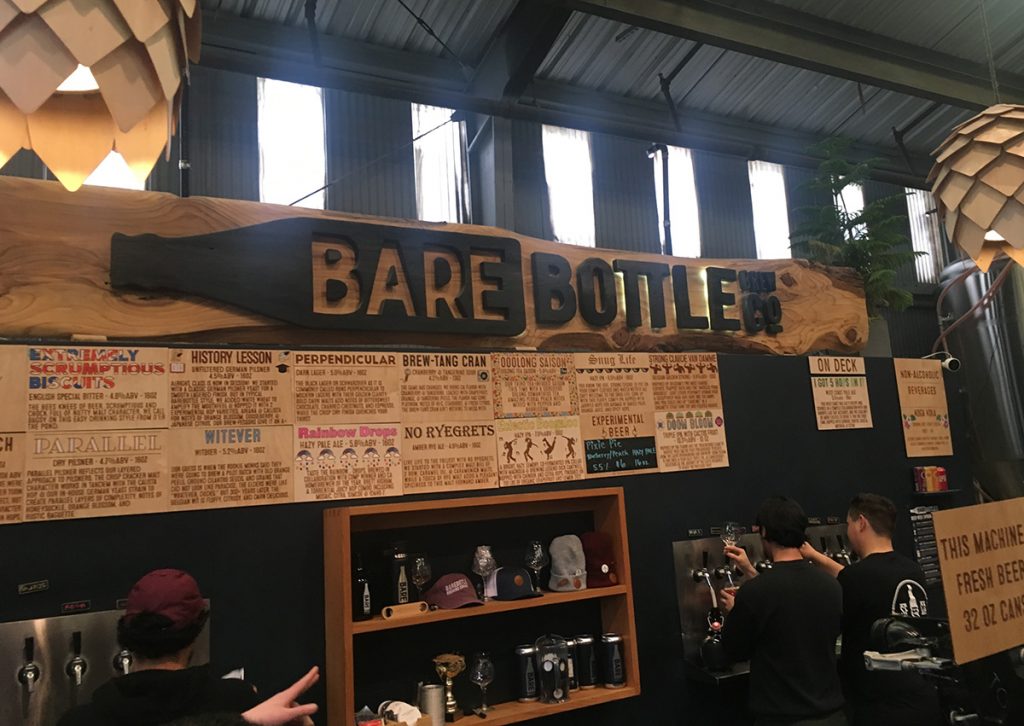
Our first stop was Barebottle, on Cortland Ave just south of The City. This was my first time at Barebottle, and I had to ask whether it was always like this. It was, to put it mildly, packed like a can of sardines. Two lines of 10-plus people each led to the bar where beer was continually flowing into glasses. Alas, this was SF Beer Week, where fans come out in droves. Part of this could be attributed to Barebottle’s release of their triple IPA, Doom Bloom, fruited with prickly pear. I can attest that this is an extremely dangerous beer in that it is so smooth you would never guess it was a triple. At least not until you picked yourself up off the floor.
Aside from the triple we tried a number of Barebottle’s hazies for which they are quite well known. The offering did not disappoint as we climbed the ABV ladder from single to double to triple. Barebottle consistently delivers high quality brews that are very pleasing to the palate.
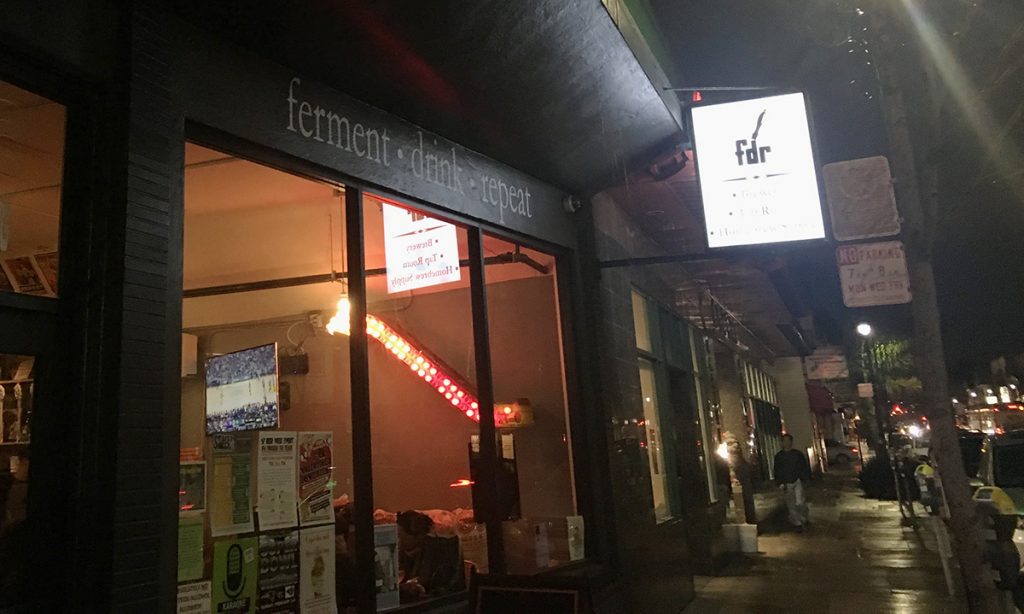
FDR in The Portola
The next stop on our excursion was Ferment.Drink.Repeat, also known as FDR. Nestled in the heart of the Portola (the pronunciation of which caused much discussion and laughter) FDR feels a bit like an anachronism. In the middle of this ordinary, neighborhood block is a very hip taproom and brewery. Flanked by a Chinese restaurant on one side and an old cinema-turned-church on the other, FDR is a breath of fresh air. Long tables invite communal drinking and the opportunity to meet and make new friends. The beer list is vast and we were treated to a time-traveling journey with a flight of beer styles from the ‘80s up to today.
More interesting for me was the brewery tour we experienced with brewer Kevin Inglin. Tucked neatly in the back is a very compact 7BBL brewhouse with four ten-barrel fermenters and two ten-barrel bright tanks. For such a tight space everything is quite well organized. I had the pleasure of having a lengthy conversation with Kevin on his philosophy of brewing which enlightened me to his passion of focusing on beers he believes in and not just chasing the latest hot beer trend. This is a topic I have discussed with other brewers — where to draw the line between brewing beer you want to make and drink, and beer that will sell and pay the bills. Kevin at FDR is very much in the camp of sticking to his guns and brewing beers he believes in.
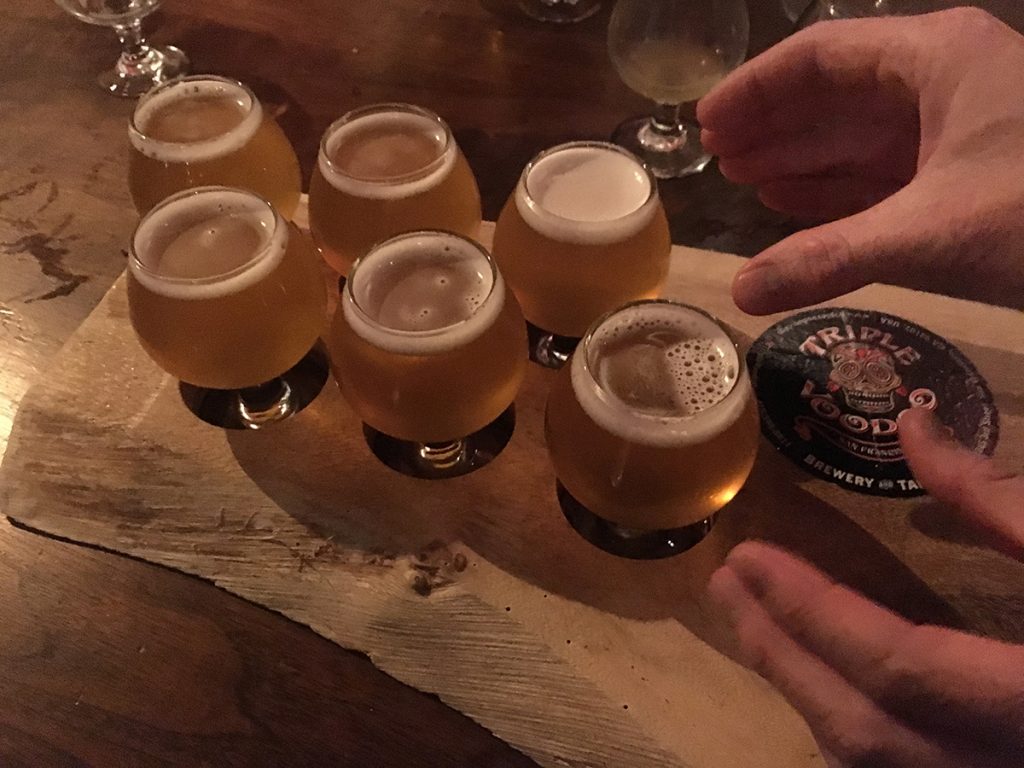
Our last stop of the night on the Hazy Train was Triple Voodoo Brewing down on 3rd St. in the Dogpatch. We ended our ride and evening not so much on the Hazy side of things. Although our first offering was the hazy Unclear Intentions, which was quite nice, we moved onto less hazy fare. Moving into dessert mode we had a velvety chocolate porter, Imperial Mocha Shake. Then as a nod to the dream-filled movie, we next had their Belgian-style ale, Inception. We rounded out the night with an amazing double IPA, Angelheaded Hipster.
On the whole, the event was a great success. Being driven around to multiple breweries is something most people can get onboard with. Meeting new people from a variety of backgrounds who are all passionate about beer made for great comradery and conversation. And having two guides who were knowledgeable, entertaining and dedicated to the idea of us having a good time was a winning combination.
SF Beer Week 2019 is rapidly approaching. Excitement is building and as if there weren’t already a ton of events planned, more and more are being added.
I was lucky enough to be invited to the SF Beer Week preview night, for an evening of beer tasting, food and conversation with a variety of brewers and brewery employees from the Bay Area brewing scene.
Living in the Bay Area, we are blessed with an embarrassment of riches in regard to the beer offerings available to us. However, traversing across the far reaches of the Bay Area is not always an option. When you imagine Alvarado St. in Monterey and Russian River in Santa Rosa, they aren’t exactly close by one another. One of the most exciting things about SF Beer Week is the opportunity it offers to try the wide variety of Bay Area Beers on offer from all around the region. And possibly the best opportunity to find most of these beers in one place is the Opening Gala on February 1stat Pier 35.
Lester Koga, head brewer at Barebottle Brewing, loves the energy of SF Beer Week. “I love to see all the crazy things all the other breweries are up to.” Lester also pointed out that the Opening Gala is not to be missed. He says it’s the single best beer event of the year in the Bay Area, so be sure to get your tickets soon for that event.
Another exciting event, being hosted by HenHouse Brewing, is The Roost. If you are interested in intimate beer dinners with a beer-centric dining experience, this may be just for you. Each night, The Roost will feature the same beers paired with an entirely new menu, created by a different chef. Each dinner will be limited to 25 seats and actively hosted by that night’s chef and one of the HenHouse squad of cicerones.
All around the Bay you can be sure expect there will plenty of Hazy offerings on hand, but there are quite a few “big beer” events as well. There are plentiful triple releases planned, as well as a number of library tastings, which promise to offer rare and no longer available beers.
While looking over the event schedule can be a bit overwhelming, the website has a lovely little tool for you to tag events that look interesting and then go back and “manage” all the ones you have tagged. You may have to make some sacrifices, but rest assured there will be plenty of great beer and lots of good times to be had at SF Beer Week. So don’t wait, and get planning.
If you are familiar with the craft beer scene in the South Bay and even more so if you live near Campbell, you have probably had the pleasure of enjoying some beer at Out of the Barrel in The Pruneyard. Tucked into a corner near Peet’s Coffee and a few doors down from Rock Bottom, Out of the Barrel has found a steady following, and turned some heads with their stellar tap list.
I had the opportunity to sit down with Out of the Barrel owner Evan Jaques and discuss his path into beer and how he has found success running his taproom.
Evan Jaques, owner of Out of the Barrel.
Evan grew up in Campbell, but now calls Morgan Hill home. His passion for beer started while studying at UC Davis, where he took an Intro to Beer and Brewing class taught by Charlie Bamforth. That class inspired him to drink something other than Natty Light, which was “the beer of choice in college.”
OUT OF THE BARREL IS BORN
Out of the Barrel was originally born as a sales and marketing company to support small craft breweries. After college Evan began working for his father’s construction company, but realized he wanted to get involved in the brewing industry. Out of the Barrel was intended to be a side gig to his day job working for his father — a little bit of joy on the side to balance out the frustrations of the day job. Things went well and Evan proved to have a knack for selling beer.
THE BAREBOTTLE DISCOVERY
While touring breweries in San Francisco, Evan ended up falling in love with Barebottle Brewing. He loved the branding, he loved the taproom, and he loved the beer. Barebottle wasn’t interested in a distributor; they did, however, need a sales rep for the South Bay. So instead of becoming their distributor, he took a job with them. They only had one account in the South Bay, but they soon exploded in popularity.
Eventually the frustrations of working in construction became too much for him and Evan decided to make the leap to working full time in the beer industry. Evan saw the huge success of taprooms like Taplands, Original Gravity, and Running Shop and after some back-of-the-napkin math, he realized it truly was doable to open a new taproom.
The location in The Pruneyard seemed like a good fit. A massive remodel was underway to make The Pruneyard a much hipper place to be and the The Pruneyard was receptive to Evan’s idea of a taproom.
There was a lot of potential in the area around Out of the Barrel that also got Evan excited. “The demographics in Campbell are amazing for what I’m trying to do.” With Peets, Burger Lounge and soon Luna Mexican Restaurant, there was a lot of foot traffic that could be attracted to Out of the Barrel.
THE IMPORTANCE OF THE TAP LIST
As Evan said, “I’m trying elevate the type of beer this community enjoys. So, I want to bring in the best of the best at all times. I want to find the best breweries out here and bring them to this local community, so that they can fall in love with the beer as much as I have. That’s the whole point. Spreading good beer to this community.”
Out of the Barrel works almost exclusively with self-distribution accounts. These are breweries that don’t have a distributor, like Fieldwork, Barebottle, Alvarado, Casa Agria, Moonraker, and Rare Barrel. That list alone would make most craft beer fans pick their chins up off the floor.
QUICKLY SUCCESSFUL
“This has been wildly more successful than I thought it was going to be. We beat our sales expectations based on my business plan by roughly double within the first three months of being open.” They have been very consistent with sales through the summer, but they are bracing for a slowdown in the winter, which is to be expected.
AN INVITING ATMOSPHERE
Evan credits part of the success of Out of the Barrel to creating an atmosphere where people feel comfortable enough to bring a co-worker or a boss, their parents or friends visiting from out of town. The ultimate goal was to create an open atmosphere where anyone from any walk of life (as long as they are over the age of 21) could come in and have a good, relaxing time. Evan feels that his staff has been amazing at creating that kind of atmosphere. He stressed the importance of that when he hired them. It wasn’t so much whether they had a lot of experience with beer or with bartending, but they needed to have the right attitude to help foster the kind of atmosphere he wanted for Out of the Barrel.
LANDING THE BEST OF THE BEST
How did Out of the Barrel get the hottest breweries in the Bay Area to sign on to their tap list? Part of it was just plain luck. Also, being in the industry, working for Barebottle, and knowing the right people helped. Above all, it was developing relationships. Evan met with the guys at Alvarado months before opening and planted the seed that they were one of his top choices and he needed to have them on his tap list. Amazingly they agreed, despite the fact they do not accept new accounts. Evan was able to develop a rapport with them and work his relationships to allow them to see a great partnership. Another factor is that these breweries know that Out of the Barrel is storing the beer properly, serving it properly, and moving the product. “You need to show these kinds of breweries that you actually care, and you aren’t there just because you want their name.” Out of the Barrel explains their passion for beer and how it needs to be served and these top breweries recognize that.
FLYING BEER IN
The story of Moonraker is an amusing one. Evan also met with them months before he was going to open. He took them some beer and tried to start things off on the right foot. He told them his story and how he really wanted to have them on tap when he opened his doors. They were receptive to his pitch, but as opening day approached, chaos set in. There was so much to do to ensure a successful opening and yet he still needed to drive all the way to Auburn to pick up his Moonraker kegs. Evan’s wife suggested he reach out to a friend who has a plane and get him to fly him. His friend was down for the idea. They landed at the airport right across the road from Moonraker, grabbed the kegs, and flew back. It was a bit of a coup to have Moonraker on tap the day they opened their doors.
HOW DO BREWERIES GET ONTO OUT OF THE BARREL’S RADAR?
The way Evan looks at the tap list is like a competition. He wants to feature the best of the best at all times, and have as many beers from a single brewery as he can. He wants to recreate the same experience you get from going to a brewery and seeing their full draft list. So he looks for breweries that can knock it out of the park across a variety of styles, not just, say, Hazy IPAs. He wants to see them make a great Pilsner, a great West-Coast, and a great Stout as well. So rather than have 22 random beers on tap, he wants to have a feature across several different breweries.
SAYING NO TO THE BIG BOYS
Early on the big distributors came to Out of the Barrel hoping to get some tap handles, but Evan feels they have so much business everywhere else that they don’t need to be represented at Out of the Barrel. That is why you will probably never see Russian River’s Pliny the Elder on tap at Out of the Barrel. While Evan thinks they are a fantastic brewery and he would love to have their beer, they are with DBI, one of the largest distributors in the area. Out of the Barrel would prefer to save room on the tap list for the smaller, independent, self-distributed breweries.
LOOKING TO THE FUTURE
Out of the Barrel has signed a long-term 5-year lease. The hope is to maybe get more patio space allocated to Out of the Barrel to make it more enticing. Another plan for the future is to put in a glass accordion door where the front wall is, so in the summer they can just open that whole wall up and make it much easier for people to come in and out.
As the craft beer industry races towards 7,000 breweries nationwide, there are signs of the growth starting to flatten out. New breweries are opening, but many are also closing their doors. Evan isn’t concerned by this trend. “Beer has been around forever. It’s not going anywhere. People aren’t going to suddenly wake up and decide they don’t like good beer. Even if the economy crashed tomorrow, people are still going to buy beer.” And I can tell you one of the best places to find good beer is at Out of the Barrel.
From the beginning, Humble Sea quickly found a passionate fan base in Santa Cruz, but given their smaller size they struggled to keep up with demand. Not exactly a bad problem to have, but one that frustrated the owners. About a year in they were able to add a new 30BBL fermenter, which helped relieve some of the strain and keep more beers on tap for the many faithful patrons pouring through the doors. But if you happened to go into the brewhouse you would have thought, “Wow, they really crammed that new tank in here.” Things were tight. Really tight.
TIME TO GROW
It had always been in their plans to expand into the other bays in their building. It was just going to be a matter of time for them to open up. Well, that time finally came in September of this year. The lease came up for the bay right next to the brewhouse and their landlord was kind enough to offer it to Humble Sea. They took down the wall, opening up an additional 1000 square feet of production space to their existing 1600 square feet.
It doesn’t look all that pretty right now. It is currently being used just to store their empty kegs and as a holding space for cans when they do can releases, but soon this space will be home to three new 40BBL fermenters and two 20BBL horizontal lagering tanks. Yes, you read that correctly: “lagering tanks.” Although Humble Sea has very much made their name on their amazing hazy IPAs, head brewer Nick Pavlina has always had a passion for brewing lagers. Lagers are a much more difficult beer to make, because there really isn’t any way to cover up mistakes. The clean crisp taste of a lager is very nuanced, and the slightest off flavor or discoloration is front and center in the glass.
GOODBYE TO GUEST TAPS
If you have been to Humble Sea in the past, you might have noticed how they commonly had a few guest beers on tap. This too helped relieve some of the strain on their ability to keep up with demand. But as you can imagine with all those new fermenters, there will be little need for guest taps. As taproom Manager Taylor West told us, they “loved being able to have beers from a good friend’s brewery or whomever you are doing a collaboration with, to showcase that beer. But at the same time, it’s more important to have our beers on the beer board.”
A BIG NEW BEER GARDEN
Another exciting development they have coming down the pike is to expand their beer garden on the railroad side of the building. The plan is to add an additional 4000 square feet of beer garden space. The current beer garden in front, while cozy and fun, is often quite full, leaving some patrons standing and waiting for seats to free up. The goal is to make enough beer to not only keep the beer board full, but to satisfy a much larger beer garden as well. As Taylor mentioned, it’s a gamble. They really don’t know if enough patrons will show up to fill that new space and drink the tremendous amount of additional beer they will be brewing. The expectation is that the people will come. And while I absolutely want Humble Sea to be amazingly successful with this expansion, my hope — and theirs — is that they can start to provide more beer to accounts outside of Santa Cruz and throughout the Bay Area.
We have started to see Humble Sea pop up in a few select places on the inland side of the hill. It has been rather select, though. While it’s nice to have a “rareness” quality to your beer, as Russian River has been so successful with, I would love it if more people throughout the Bay could enjoy the magic that is Humble Sea without having to go to Santa Cruz.
MORE BEER MEANS MORE BREW TIME
With their current set-up, Nick brews three to four times a week. But with an additional 160BBL of tank space, the plan is to start brewing five times a week and on some days brewing double batches in order to fill up those huge tanks. It means a lot more work, but having witnessed the vibe in the brewhouse first hand I can imagine they will tackle the extra hours with gusto and the enjoyment that comes with brewing beer for a living.
These are exciting times not only for Humble Sea, but for the patrons who enjoy their beer. Less than two years old, Humble Sea has found sure footing in the craft beer scene and they have a loyal band of followers. While expansion has always been on their minds, Taylor says they are “not looking to over expand, but looking to provide the right amount to satisfy the demand we have now.” Over the next few months, it will be exciting to see these plans take shape and hopefully reach more craft beer drinkers, who will surely become fans of the Humble Sea.
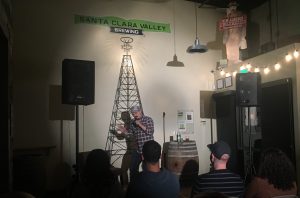
Brian Moore, Santa Clara Valley Brewing, MC of the night.
For breweries with taprooms, there are a lot of different ways to get people through the doors. The most obvious is having damn good beer that people want to drink, but even that doesn’t guarantee that people will come storming through the doors. There are so many factors that play into whether people will find your brewery and keep coming back.
Many breweries have started having special events in order to draw patrons to their taprooms, from yoga events, to discounts for bringing pets along, to food trucks that provide specific culinary accompaniments to their beers.
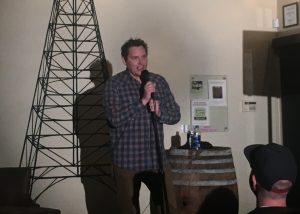
These all seem logical and have proven successful, but recently Santa Clara Valley Brewing took a leap of faith and tried something new. On September 29ththey hosted their first Comedy Night featuring local talent Avery Harmon and husband and wife duo Tom and Steph Clark out of Los Angeles.
Santa Clara Valley Brewing transformed their taproom into a comedy venue. To be honest, they didn’t do a whole lot aside from adding a small stage and some lighting, but when you look at the pictures below, it actually looks kind of legit.
The evening started with the MC of the night, BMO, Santa Clara Valley’s own Brian Moore. Brian is a very dynamic and funny guy, so it made sense to get him up there in front of the crowd. Brian dove with full gusto into his own comedy routine, risking life and limb by making fun of his fiancée’s father. His delivery and accent were spot on and laughter filled the room. Not sure how his future wife felt about his act.
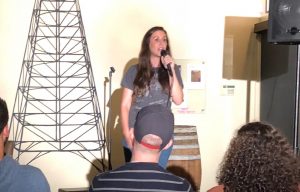
Steph Clark working the room.
Up first was Steph Clark. She found her rhythm quickly and began working the room. Steph’s delivery was relaxed and free form. The audience found her very relatable and truly funny. She locked into various people in the audience and worked their backgrounds into her comedy.
Coming into the evening I noticed that Steph and the headliner had the same last name and I made the correct assumption that they were married. I was hoping for some back and forth between their acts, and there were moments when they acknowledged their relationship, but they didn’t dive into trashing one another. Probably for the best.
Avery showing off his watch that doesn’t work.
Following Steph was local talent Avery Harmon. Local might be a misnomer, because he is originally from Chicago, but he currently calls San Jose his home. Avery is very comfortable on stage. His comedy is quick and unrelenting. You have to keep up or you’ll fall behind. Some might find this off-putting, but I found it refreshing and challenging. Pay attention, yo!
Avery’s day job is school teacher for pre-K through elementary. One can imagine there is ample fodder for comedic material there. Some of Avery’s coworkers showed up to cheer him on, and late in the show, it was revealed that a parent of one of his students was at the show. Much comedy then ensued around the idea of a beer-drinking, foul-mouthed teacher of very young children.
The headliner of the night was Tom Clark. Those in the know would find his name both surprising and hilarious, as one of the co-owners of Santa Clara Valley Brewing is named Tom Clark. As it turns out, the two of them met at an event and began a friendship that eventually resulted in this comedy night.
Tom Clark, funnyman extraordinaire.
Although Tom isn’t yet a household name, he should be, especially after his performance at Santa Clara Valley Brewing. Rarely have I laughed that hard, and I saw Andrew Dice Clay at Universal Studios back in the ‘90s. Tom is one of those comedians who can freeform, going off on tangents based on the locale or people in the room and riff on a variety of topics, resulting in howls of laughter. He obviously had an act and standard jokes, but he quickly veered off script and began working the room and riffing San Jose.
The absurdity of his situation was not lost on him. Here he was, in a brewery in a warehouse district in San Jose performing in front of 52 people, when the previous weekend he opened for Jim Gaffigan and a crowd of 13,000 people. He took great amusement in making fun of the Electric Tower mural on the wall behind him. To many San Jose natives, the Electric Tower is a symbol of pride, but to Tom, the tower was unknown, and he found the mural to be unremarkable and the source of much comedic banter.
That’s me, trying to breath while I laugh so hard.
Another joke he was working his way towards was a joke about a zoo. He began by remarking how great the zoo in San Jose was. This comment was met with confusion and a titter of laughter in that he was sorely mistaken about San Jose’s zoo status. Being from San Diego, I yelled out “We’re not in San Diego!” Maybe it was being heckled or maybe it was an opportunity, but Tom launched into a ten-minute diatribe, of which I was very much the butt of his jokes, that left the room reeling in laughter. I myself had tears streaming down my face and could barely breathe, I was laughing so hard. The rest of the room was also rolling in laughter. Ultimately, he got to his joke about the zoo, but it didn’t really land. However, the lead up and his freeform riffing on the room displayed the sheer brilliance of his comedy.
It was this ability to react to the room that made his performance so enjoyable and stunning. He worked in various people in the room, like the table of techies and the table of teachers. No one in the room was spared from his comedic wit, be it as co-conspirator or victim of his verbal barbs.
I truly had a fabulous time and was floored by the success of the event, and I think many others that night would agree. Add to that the always great beer selection on tap, and it was a very enjoyable night. The recently released Haze Mansion was very much appreciated and I can say a fair number of them were consumed at our table alone.
My takeaway is that comedy night was a hugely successful event, and my hope is that Santa Clara Valley Brewing can make it a more frequent event in their lineup of monthly events. It’s understandable that bringing comedians up from LA probably isn’t sustainable, but as the SCVB staff mentioned, there is a lot of comedic talent right here in the Bay Area that can be tapped. I couldn’t agree more and I can’t wait for the next comedy night at Santa Clara Valley Brewing.
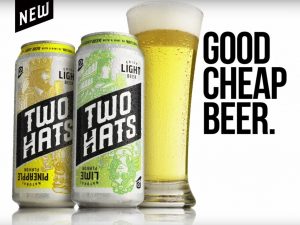
I recently read an article on the Brewbound website about the demise of a recently released MillerCoors beer called Two Hats. The article was both interesting and amusing, and very much emblematic of Big Beer’s approach to making beer.
Get ‘Em While They’re Young
The goal apparently was to reach a younger crowd, specifically 21- to 24-year-old drinkers, a demographic they have struggled with. In fact, they actually have a name and acronym for this demographic. They are “legal-drinking-age-consumers,” or LDACs. The fact that they even have this acronym speaks volumes about how they approach beer. This younger crowd has been “veering away from beer” towards cheaper wine and spirits. Which, when you think about it, suggests that these younger drinkers are looking for a cheaper way to get their buzz on. So why did MillerCoors think that making a low ABV, low-priced light beer would capture this market?
Marketing to Youngsters
Based on the article, I gather that a big part of their approach was an effort to reach this younger drinking audience through social media marketing. I’m picturing focus groups sitting around looking at ads while ad execs toil over their various reactions. I’m sure teams of designers and copywriters were trying to crack the code that attracts this younger audience and convince them that Two Hats is just the beer for them. And yet from my perspective they were ignoring the most important factor in the equation: actually making a good beer.
Oh Wait, We Need to Make the Beer Too
The actual beer seemed to be an afterthought. I could be totally wrong, and to their credit MillerCoors claims to have tried to make a “great beer at a great low price.” There is much evidence to the contrary, however. They released a 6-pack of 16oz Tall Boys at a $5 price point. Yes, you read that correctly, $5. Keep in mind that most 4-packs of 16oz craft beer Tall Boys start at $15 and go up from there. So, they are selling one third more beer at one third of the price. How can they do that? Some people might argue it’s volume. At the volume they are producing they can bring the price down. I’ll agree that to some extent they can, but not that much. The more logical answer is cheaper, inferior ingredients. I would venture to say that corn or rice make up a good part of the grain bill instead of all barley. And you can be pretty sure they aren’t using high-quality hops like Citra or Mosaic. The idea that you can make a great beer at that price point seems to be just stupid.
What’s in a Name?
And let’s move on to the thinking behind the name. Apparently “the name Two Hats is meant to reference the two hats that young adults wear to balance work and play.” I’m guessing that MillerCoors didn’t get the memo, but metaphors just don’t fly with beer names. People don’t want to ponder the meaning behind the name. They don’t stand outside the refrigerator case and think, “I wonder what that could mean.” They would rather see a pun and get a little laugh out of it. Stuff like “Wetsuit Dreams” or “Hazing Saddles.” You look at those names and know immediately what the joke is. And ironically, there was probably a team of people who were really proud of the name they came up with for Two Hats. I’m sure a lot of back slapping was going that day.
At the end of the day it’s no wonder that MillerCoors had to eventually pull the plug on Two Hats. I’m not saying you can’t make a good light beer, but you need to start with that. Focus on the beer first and work on the rest after you’ve figured out the most important part of the equation. And as for price, you get what you pay for. If you want quality ingredients, a craft style and good flavor, then chances are you are going to have to pay for it. And if the LDACs don’t want to pay for that, then let them get their buzz on with cheap wine and booze. And to be honest, the independent brewers aren’t going to miss them.
When I heard a brewery was opening in my neighborhood, I was quite excited, to say the least. And when I finally set foot inside their doors and tried their wares, I was not disappointed.
Hapa’s is a confluence of many fortunate events, the foundation of which is the high-quality beer that brewer Brian Edwards creates. As Brian puts it, his role is to take all the raw ingredients and guide them through the brewing process until they end up in your glass. That’s where his job ends.
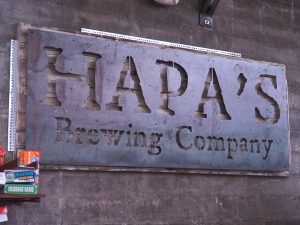
The name Hapa’s is catchy in that for most it’s an unknown word. I’ll admit I first thought it was a made-up word that was a play on the word hops. But as owners Derek and Brian explain, it’s very much a real word.
LOCATION, LOCATION, LOCATION
Aside from the myriad of things that make opening a brewery a steep hill to climb, finding the right location is among the toughest. Many breweries are located in industrial/warehouse districts that don’t exactly lend themselves to foot traffic. Patrons have to seek out these locations and even then, they can be hard to find. Finding a location that fits both the industrial needs of a working brewery and has drive-by traffic is a goldmine. In that sense Hapa’s hit pay dirt. While it isn’t in the heart of Willow Glen, it really isn’t far from downtown Willow Glen. And that means a lot of patrons can make it there easily.
Aside from the physical location, the structure and environment lend themselves to people having a great time. It has a huge open feeling with high ceilings and tons of natural light. There is plenty of space to move around and an outdoor area with plenty of seating and the opportunity to play cornhole. The vibe in the Hapa’s taproom is a huge part of its success.
A LONG JOURNEY TO OPENING
A typical patron enjoying the beer and environment at Hapa’s will never know the multi-year journey that Derek and Brian took to make Hapa’s a reality. Both entrepreneurs at heart, they kicked around multiple business ideas before landing on the idea of opening a brewery. Both were passionate about brewing but were working in tech at the time. Brian took a huge leap of faith and quit his job at Google to take a job at Dempsey’s Brewery in Petaluma. Under the tutelage of Peter Burrell, Brian learned everything it takes to brew quality beer and run a brewery. And he learned it the hard way. As Brian puts it, he went to “the school of hard knocks” for brewing.
The brewhouse at Dempsey’s was not very modern. When Dempsey’s opened, automation of the various tasks was either not available or not affordable. That meant that after milling the grain, Brian would hand carry the buckets of grain to add to the mash tun. Keep in mind that often meant hundreds of pounds of grain. Once the grain was in the mash tun, there were no rakes to mix the mash, so Brian had to hand stir the mash with a paddle. Imagine stirring 400lbs of oatmeal. The side benefit of course is a great workout. People often imagine brewers as being overweight from drinking so much beer. The opposite is often true because of all the physical labor involved in brewing.
FOCUS ON STYLE
A lot of breweries tend to lean one way or another in terms of style of beer. That isn’t to say they don’t cover most of the bases, but once those standard styles of beers fill out the tap list you will find the extras tend to lean towards specific styles. One place may be heavy on the hazies, while another might have an amazing sour collection. Whatever that may be, there can be a wide range of possibilities within a specific style, as Brian explains here.
DISTRIBUTION
As homebrewer you mainly are brewing beer for yourself and your friends. Cost savings may cross your mind, but profit certainly doesn’t. But a brewery is a business and without profit you won’t last long. (Unless you are Twitter.) And the question then is, how do you sell your beer? Sounds easy, right? Not so much. There are over 6,000 brewpubs, microbreweries, and regional breweries in the United States, and the concentration in certain areas in immense. You either have to convince people to get through your doors or get your beer out to the bars, restaurants and grocery stores. For a brand-new brewery without a well-known name that is tough. Adding your beer to a tap means moving another one off. Putting your beer on the shelf means less room for other well-known beers. Breaking in can be very frustrating.
GETTING TO KNOW YOUR CUSTOMERS
Obviously without customers a brewery wouldn’t last very long. Developing a relationship with your customers is key not only to growing your customer base but also to ensuring repeat customers. As enticing as the environment at Hapa’s is, the staff help add to that with their friendly, helpful attitudes. The one unique relationship is that of the brewer with the patrons. Since the brewer spends the majority of their time in the brewhouse, they don’t always have the opportunity to mingle with patrons. And when they do it can be fraught with the insecurity of an artist walking among visitors at an art gallery. Do they like my beer? If they don’t, why not? Brian explains his experience with this, and his way of dealing with it.
PUCKER UP
One question that Hapa’s was unprepared for was “Do you have a sour beer?” The answer was no. To make things worse, Brian didn’t even really know how to brew one. Sours are a style of beer obviously defined by their sour flavor, but beyond that the style is pretty much wide open. And often the magic and beauty behind the style are the unexpected results. Introducing bacteria to your beer is a very uncontrolled method of defining the flavor and it can take years to understand and perfect the style. But as Derek and Brian explain, the pressure was on to make one.
COLLABORATION
As I discussed in my blog post about Humble Sea, the brewing industry as a whole is unique. The openness and camaraderie among fellow brewers is really astounding. While some may be a little protective of their exact recipes, the sharing of ideas is commonplace. Helping one other out when one is short on this or that ingredient happens all the time. I’ve even seen them borrow equipment from one another and payment at the end is usually a case of the beer they brewed that day. It’s heartening to see an industry that can thrive in an environment of cooperation rather than competition.
While Hapa’s is still very young — they recently celebrated their one-year anniversary — they seem to have a very bright future ahead. Judging by the crowds in the taproom on the weekends, they must be doing something right. They recently added a new fermentation tank to help increase volume and keep the tap list filled with a variety of beers. While Brian continues to maintain his staple beers, Hungry Dog, Amish Rifle, and Barbie’s Blonde Ale, he keeps thing fresh with new hazies and zero-IBU IPAs each month. Recently he experimented with the new brut IPA style, which came out quite nice. It’s crystal clear and quite refreshing, with low bitterness. Time will tell if this style catches on.
As the San Jose beer scene grows, Hapa’s will undoubtedly be among one of the top spots for beer lovers. I can only imagine the name will grow in recognition in the stores and taps in restaurants and people will come to seek out Hapa’s wherever they can. I for one will always have it as my “neighborhood brewery,” and for that I am thrilled.